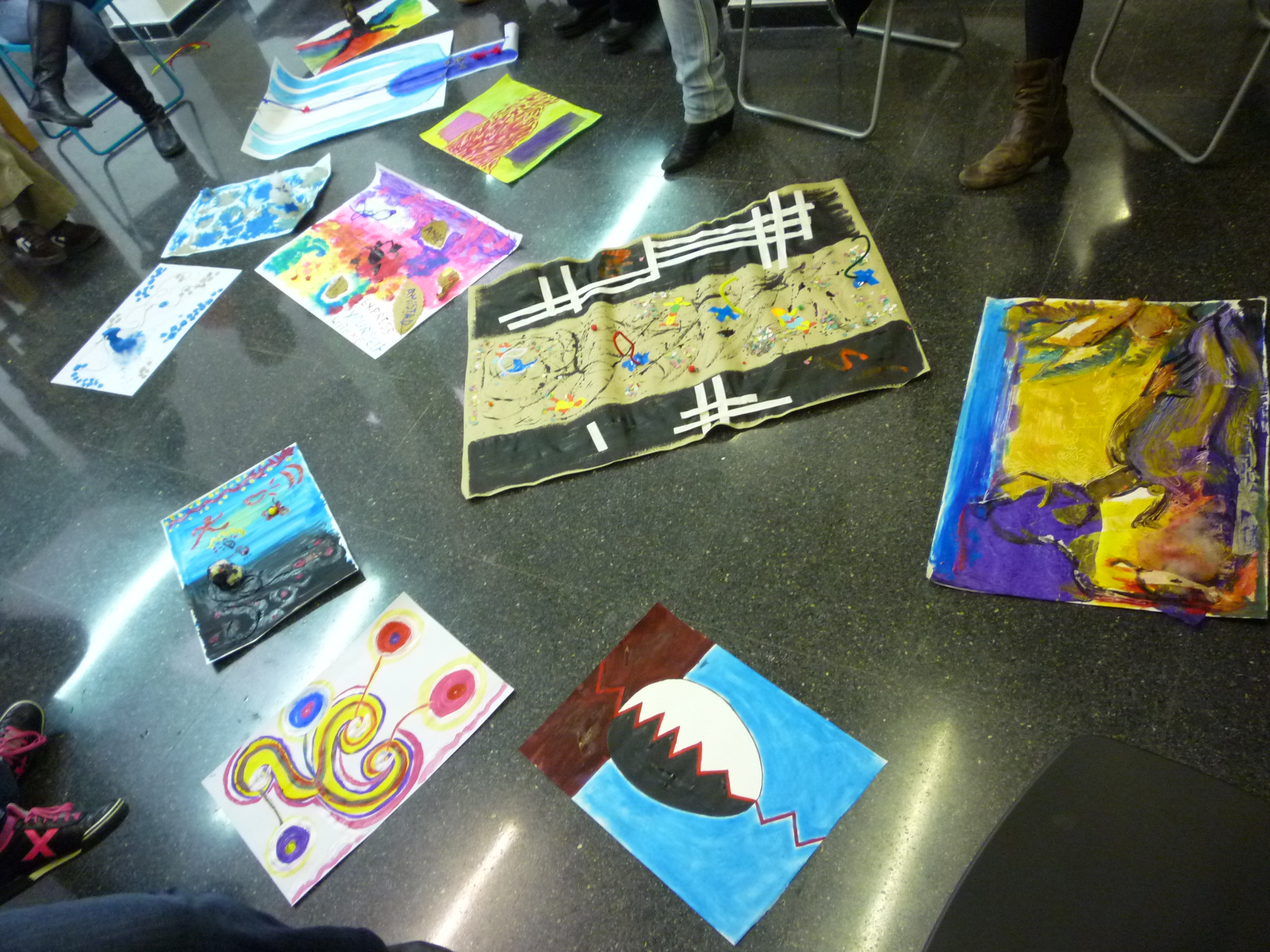
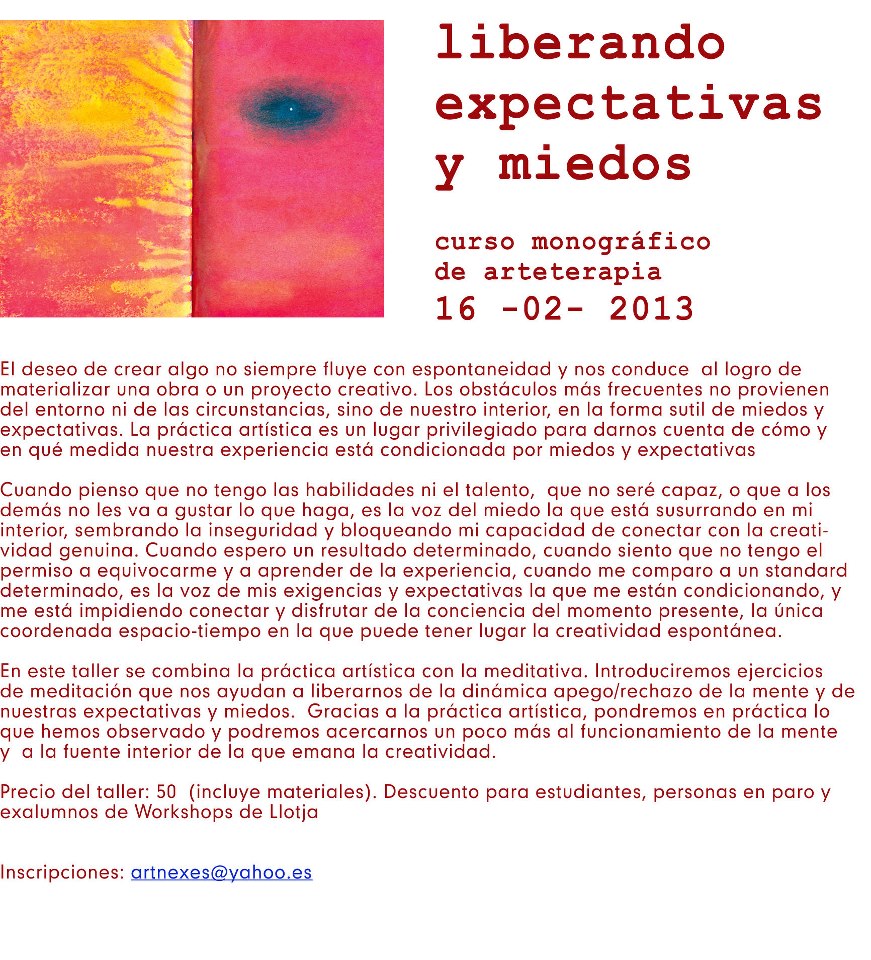
Esta mañana he tenido la oportunidad de participar en un taller de arteterapia impartido por Magdalena Durán. Es el segundo de una secuencia que empezó en enero, y en el que abordamos el tema de «el cambio». El tema de hoy ha sido «Liberando miedos y expectativas». Se desarrollan un sábado al mes, de 10 a 14 de la mañana y están dirigidos a arteterapeutas, educadores, trabajadores sociales, artistas, estudiantes de arte y cualquier persona interesada en el crecimiento personal.
liberando miedos y expectativas
No son necesarios conocimientos previos de arte para participar.
Su enfoque parte de la psicoterapia existencial de Yalom, el psicoanálisis de Winnicott, la Gestalt, prácticas meditativas de la psicología budista, y de su formación como arteterapeuta.
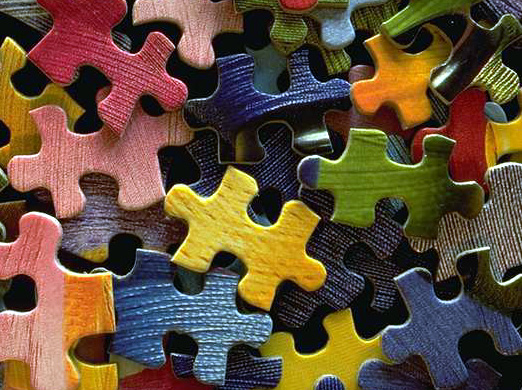
«Tanto en los talleres de Mediación Artística como en sesiones de Arteterapia, en el acto de la representación el sujeto parte de fragmentos de experiencia, de recuerdos, de emociones, que constituyen algo así como un puzzle o diferentes piezas con las que se persigue construir algo. Sin embargo ese puzle no está completo, faltan piezas. Durante el proceso de creación se le da un sentido a esas piezas, se les atribuye un significado. Desde la subjetividad los sucesos, las imágenes y las emociones adquieren un significado. Se trata de una construcción narrativa donde la realidad se perdió para siempre. La palabra o la representación dotan a los fragmentos del pasado de un nuevo sentido, resignificando la propia historia. A la vez los relatos pueden, y deberían, transformarse con el devenir del tiempo. Aparecen nuevas significaciones y otras antiguas desaparecen, dando sentido a una identidad múltiple, en constante movimiento. Y todo ello sucede desde un cuerpo que se inserta en el presente y que alberga a la vez una memoria, tanto consciente como inconsciente, de todo lo vivido». (Fragmento del libro que estoy escribiendo sobre Mediación Artística)
Freud, en este texto, titulado: «Construcciones en el análisis», aborda este tema desde la perspectiva del psicoanálisis.
For women with breast cancer, combining creative art therapy with Mindfulness-based Stress Reduction (MBSR) in an 8-week program changed brain activity in ways that are associated with lower stress and anxiety.
Cancer and stress go hand-in-hand, and high stress levels can lead to poorer health outcomes in cancer patients. Previously, lead author Daniel Monti, MD, of the Jefferson-Myrna Brind Center of Integrative Medicine has published on the success of Mindfulness-based Art Therapy (MBAT) in helping cancer patients lower stress levels and improve quality of life.
“Our goal was to observe possible mechanisms for the observed psychosocial effects of MBAT by evaluating the cerebral blood flow (CBF) changes associated with an MBAT intervention in comparison with a control of equal time and attention,” said Monti. “This type of expressive art and meditation program has never before been studied for physiological impact and the correlation of that impact to improvements in stress and anxiety.”
The investigators randomly assigned 18 patients to the MBAT program or to a control group that received an education program. All of the enrolled patients had received the diagnosis of breast cancer between 6 months and 3 years prior to enrollment in this study, and all the patients were not in active treatment. The MBAT program consisted of MBSR curriculum, which included awareness of breathing, awareness of emotion, along with mindful yoga, walking, eating, and listening. This was paired with expressive art tasks to provide opportunities for self-expression, facilitate coping strategies, improve self-regulation, and provide a way for participants to express emotional information in a personally meaningful manner.
The patient response to the MBAT program was measured with a 90-item symptom checklist that the patients completed before and after participating in the 8-week program. In addition, functional magnetic resonance imaging (fMRI) evaluated CBF both before and after the program to assess changes in the brain’s activity. Scans were performed at rest, during a neutral task (control), meditation task, stressor task, and at rest again. This series of scans was designed to evaluate the general and specific effects and to provide a thorough analysis of the CBF change between the pre- and postprogram scans.
Participants in the MBAT group demonstrated significant effects on cerebral blood flow compared with the control group. The MBAT group showed increases in the emotional centers of the brain including the left insula which helps to perceive emotions, the amygdala which helps to experience stress, the hippocampus that regulates stress responses, and the caudate nucleus that is part of the brain’s reward system. These increases correlated significantly with a lowering of stress and anxiety, as also reflected in the results of the pre- and postprogram anxiety scores among the MBAT intervention group.
Given the improvements in anxiety levels and observed changes in CBF in the MBAT participants, these findings suggest that the MBAT program helps mediate emotional responses in women with breast cancer.
This study was published in Stress and Health (2012; doi:10.1002/smi.2470).
Del 11 al 14 de julio de 2013, en Victoria.Con la celebración de este congreso queremos crear un espacio de diálogo, experimentación y comunicación entre profesionales que posibilite abrir caminos en el marco de las Terapias Creativas para su asentamiento y evolución en la búsqueda de la salud, tanto individual como social. Para ello estamos trabajando en un programa articulado alrededor de las diferentes Terapias Creativas (Musicoterapia, Arteterapia, Dramaterapia-Teatroterapia y Danzaterapia), tomando como base diálogos con el Dr. Héctor J. Fiorini como hilo conductor. Esto nos servirá como base para reflexionar sobre el papel de la creatividad en la generación de salud y equilibrio dirigido al conjunto de la sociedad. Para determinar la configuración final del contenido del programa del congreso, así como la presentación de las distintas mesas y talleres* se ha determinado un Comité Científico conformado por profesionales de las distintas ramas de las Terapias Creativas procedentes de colectivos organizados que abarcan las distintas disciplinas, y que han sido elegidos por votación interna entre los representantes de las distintas asociaciones.
De esta manera el Comité Científico está compuesto por:
D. Patxi del Campo (Instituto MAP).Presidente del Comité Científico.
D. Miguel Ángel Diví (CREARTE).Presidente del II Congreso Nacional de Terapias Creativas (Zaragoza 2011).
Dña. Patricia Sabatella (AGAMUT) y Dña. Amparo Belenguer (AVMT).En representación de las AA. MT.
D. Mikel Izuel y Dña. Sally Schofield (FEAPA).En representación de las AA. AT.
Dña. Heidrun Panhofer y Dña. Sara Rodríguez (AEDMT).En representación de las AA.DMT.
Dña. Claudia Fres y Dña. Monia Presta. En representación de AA.DrT/TT.
*Nota. En los próximos días se publicarán y difundirán las bases para la presentación y admisión de ponencias, trabajos y talleres a presentar en el marco del congreso.
Desde este momento, para facilitar el acceso a toda la información relativa al III Congreso Nacional de Terapias Creativas, hemos puesto ya a vuestra disposición todos los medios necesarios para que podáis seguir toda la actualidad y novedades relativas al congreso a través de distintos canales que a continuación os proporcionamos:
IV Jornadas Arteterapia, Salud y Comunidad de la ciutat de Girona Este año dirigidas principalmente a profesionales de la salud, la educación i otros relacionados con el trabajo con personas.
El dia 17 de Marzo empiezan las Jornadas. Va a ser un dia de presentación de la disciplina, presentación de casos y talleres. Inscripción a la jornada inagural abierta, 10€.
Pronto más información…
Organiza: www.grefart.com
En la literatura sobre el tema, los autores han coincidido que los objetivos básicos en el arte terapia con jóvenes víctimas de abuso sexual es la restauración y reafirmación constante de los límites debido a la transgresión de la totalidad de los límites de la persona. “Los límites necesitan ser reconstruidos trabajando en pos de que sean confiables y que automáticamente protejan al niño. (…)
PhotoTherapy Techniques: Exploring the Secrets of Personal Snapshots and Family Albums is the most comprehensive introduction to the field of PhotoTherapy available (and is also a great alternative to taking an introductory training workshop!).
Written by psychologist, art therapist, consultant, instructor, trainer, and PhotoTherapy pioneer Judy Weiser, this book explains and demonstrates each of the major techniques, and provides theoretical rationale from both psychology and art therapy contexts. It also includes many photo-illustrated client examples, case transcripts, and practical experiential «starter» exercises so that readers can immediately begin using these techniques in their own practice.
… about the «why» of your photographs and the feelings and stories they create…
«Photographs are footprints of our minds, mirrors of our lives, reflections from our hearts, frozen memories that we can hold in silent stillness in our hands — forever if we wish. They document not only where we have been, but also point the way to where we might perhaps be heading, whether or not we realize this yet ourselves…» — Judy Weiser, R.Psych., A.T.R, Founder/Director of the PhotoTherapy Centre
The Secret Lives of Personal Snapshots and Family Photographs. Every snapshot a person takes or keeps is also a type of self-portrait, a kind of «mirror with memory» reflecting back those moments and people that were special enough to be frozen in time forever. Collectively, these photos make visible the ongoing stories of that person’s life, serving as visual footprints marking where they have been (emotionally, as well as physically) and also perhaps signaling where they might next be heading. Even people’s reactions to postcards, magazine pictures, online images, or snapshots taken by others can provide illuminating clues to their own inner life and its secrets. The actual meaning of any photograph lies less in its visual facts and more in what these details evoke inside the mind (and heart) of each viewer — including the person who took it or who appears in it. While looking at a snapshot, people actually spontaneously create the meaning that they think is coming from that photo itself, and this may or may not be the meaning that the photographer originally intended to convey. Thus, its meaning (and emotional «message») is dependent upon who is doing the looking, because people’s perceptions and unique life experiences automatically frame and define what they see as being real. Therefore, people’s reactions to photographs they feel are special can actually reveal a lot about themselves, if only the right kinds of questions are asked.
How Therapists Use Photos to Help People Heal. Most people keep photographs around, without ever pausing to really think about why. But, because personal snapshots permanently record important daily moments (and the associated emotions unconsciously embedded within these), they can serve as natural bridges for accessing, exploring, and communicating about feelings and memories (including deeply-buried or long-forgotten ones), along with any psychotherapeutic issues these bring to light. Therapists find that their clients’ photos frequently serve as tangible symbolic self-constructs and metaphoric transitional objects that silently offer inner «in-sight» in ways that words alone cannot as fully represent or deconstruct.
Under the guidance of a therapist who has been trained in PhotoTherapy techniques, clients explore what their own personally meaningful snapshots and family albums are about emotionally, in addition to what they are of visually. Such information is latent in all personal photos, but when it can be used to focus and precipitate therapeutic dialogue, a more direct and less censored connection with the unconscious will usually result.
During PhotoTherapy sessions, photos are not just passively reflected upon in silent contemplation, but also actively created, posed for, talked with, listened to, reconstructed, revised to form or illustrate new narratives, collected on assignment, re-visualized in memory or imagination, integrated into art therapy creative expressions, or even set into animated dialogue with other photos. This allows clients to better reach, understand, and express parts of themselves in ways that were previously not possible.
PhotoTherapy — The Bigger Picture
As explained in the book, PhotoTherapy Techniques — Exploring the Secrets of Personal Snapshots and Family Albums, PhotoTherapy is best viewed as an interrelated system of photo-based counseling techniques used by trained mental health professionals as part of their therapeutic practice while helping clients consciously probe, and subsequently cognitively reintegrate, their photo-precipitated insights in order to better understand and improve their life.
Therefore, it is not the same thing as «Therapeutic Photography» (which is sometimes also confusingly called «Photo-Therapy», particularly in the U.K.), as those are self-conducted activities done outside any formal counseling context. People use Therapeutic Photography for their own personal self-discovery or artistic statement purposes, whereas therapists use PhotoTherapy to assist other people (their clients) who need help with their problems. While the results of doing photo-based self-exploration (photography-as-therapy; i.e., photography used for personal insight purposes, but with no therapist involved or guiding the process) often ends up being serendipitously «therapeutic» on its own — especially when using the camera as an agent of personal or social change — this is not the same as activating and processing such experiences while under the guidance and care of a trained counseling professional (photography-in-therapy; i.e., using photos and people’s interactions with them, during the therapy process, as an integral part of it).
Since PhotoTherapy is a collection of flexible techniques, rather than fixed directives based upon only one specific theoretical modality or therapeutic paradigm, it can be used by any kind of trained counselor or therapist, regardless of their conceptual orientation or preferred professional approach. This is one of the many ways that PhotoTherapy is both similar to, yet distinct from, Art Therapy — as well as the reason it can be used so successfully by a variety of other mental health professionals who are not trained in Art Therapy specifically. (Those who do have special additional training in Art Therapy, use a sub-set of PhotoTherapy techniques called «Photo Art Therapy).
The specific definitions for PhotoTherapy, Therapeutic Photography, and Photo Art Therapy are shown on the «Entry page» of this website; however these are repeated below for readers who did not enter this site from that first page:
PhotoTherapy techniques are therapy practices that use people’s personal snapshots, family albums, and pictures taken by others (and the feelings, thoughts, memories, and associations these photos evoke) as catalysts to deepen insight and enhance communication during their therapy or counseling sessions (conducted by trained mental health professionals), in ways not possible using words alone.
(Photo Art Therapy techniques are art therapy practices based on a specialized adaptation of PhotoTherapy techniques that are used only by those with postgraduate training in Art Therapy, who actively use photos as one of their art media of choice)
Therapeutic Photography techniques are photographic practices done by people themselves (or their helpers) in situations where the skills of a trained therapist or counselor are not needed — for example, where photos are used to increase people’s own self-knowledge and awareness, improve family and other relationships, activate positive social change, lessen social exclusion, assist rehabilitation, strengthen communities, deepen intercultural relations, reduce conflict, bring attention to issues of social injustice, sharpen visual literacy skills, enhance education, promote well-being, expand qualitative research and prevention methodologies, and produce other kinds of photo-based personal/emotional healing and learning.
Since PhotoTherapy is about photography-as-communication, rather than photography-as-art, NO prior experience with cameras or the photographic arts is necessary for effective therapeutic application!
And finally, since PhotoTherapy involves people interacting with their own unique visual constructions of reality (using photography more as an activating verb than as a passive/reflective noun), these techniques can be particularly successful with people for whom verbal communication is physically, mentally, or emotionally limited, socio-culturally marginalized, or situationally-inappropriate due to misunderstanding of nonverbal cues.
Therefore PhotoTherapy can be especially helpful, and usually very empowering, in applications with multicultural, disabled, minority-gender, special-needs, and other similarly-complex or marginalized populations — as well as beneficial in diversity training, conflict resolution, divorce mediation, and other related fields.
As the general public becomes increasingly comfortable with using electronic technology and digital imagery, more exciting possibilities continue to emerge for using photos as counseling tools with clients who have scanners, digital cameras, photo-manipulation software, family websites, and/or those who are able to participate in online cyber-therapy.
DEDHAM — Carla shook a tambourine, while Dorothy played the xylophone and Leni tapped her palms gently on an African drum. Vivian declined an instrument, but shimmied her shoulders when the music moved her.Their walkers stood ready and their voices were wispy with age, but the eight group members sang with purpose, remembering every word of the Doris Day classic without prompting.
“We were sailing along, on Moonlight Bay. We could hear the voices ringing . . .,” they sang.
When they had finished “love’s old sweet song” and given themselves a round of applause, Clara proclaimed the group “ready for Symphony Hall.”
This music class at Hebrew Senior Life’s NewBridge on the Charles campus is what today’s cutting-edge Alzheimer’s treatment looks like.
Medications can’t stop the disease’s inexorable damage to the mind, and stress and agitation often remain challenging despite drug treatment. But a growing number of Alzheimer’s institutions and caregivers are realizing that a musical walk down memory lane — a dance class, storytelling session, art project, or museum tour — can do more than offer pleasant diversions. They can improve a number of disease symptoms as well as quality of life.
ESSDRAS M SUAREZ/GLOBE STAFF In the music class at NewBridge on the Charles, Dorothy plays percussion and therapist Sally Harrison plays the flute. At a recent conference titled Artz and Dementia, some 150 Boston-area health professionals gathered at NewBridge on the Charles to learn how to provide the most benefit for people who are losing mental abilities.
The basic idea is to use art to engage and connect with people with dementia, said John Zeisel , president and cofounder of Hearthstone Alzheimer Care. No matter how many memories they’ve lost, an essential piece of who they always were still remains, said Zeisel, author of “I’m Still Here,” a 2009 book that focuses on this approach.
“It’s a human rights issue that everybody needs to be able to have a life,” Zeisel told conference attendees. “What is a life without creativity and art and discovery and learning?”
Even people who were not artistic or music lovers in their youth can be inspired by the sound of a song they heard on their first date, or by a painting that evokes an emotion, the speakers said.
For one woman, listening to Frank Sinatra brought her back to the happy summers of her teens when she would fall asleep by the radio, Marian Brown, associate director of Artz: Artists for Alzheimer’s, told the crowd. “For her, it was very clearly something that triggered a deep-rooted memory,” Brown said. Recent memories and thinking ability may decline with Alzheimer’s, but long-term memories are still there, as are emotions.
“We don’t lose the ability to express joy,” added her colleague, Dee Brenner, Artz program coordinator.
The two help organize weekly local museum tours for people with Alzheimer’s, and walked conference audience members through some basic strategies for making such visits successful: Greet people when they arrive, remind them where they are, and make sure the artwork is big enough to be visible to a group.
“How does this make you feel? What do you see?” Brenner asks when leading a tour. She’ll avoid violent or disturbing images — but not sexual ones, which spur conversation, she said.
One of the key benefits of doing or appreciating art, Zeisel said, is that it challenges people who are usually doted on. “When you are cared for, you lose your sense of who you are,” he said. “Everybody with dementia has a lot going for them. They can experience, they can be present, and they can develop.” In the six facilities Zeisel’s organization runs in Massachusetts and New York, residents are encouraged to participate in regular artistic activities. They can usually choose between two activities at a time, and can also opt out.
At Hearthstone’s Marlborough residence, some 35 of the home’s 45 residents used to get agitated in the evenings, a common problem in Alzheimer’s known as sundowning. But when music therapist Joshua J. Freitas started playing soothing instrumental music at dinner time — he’s partial to recordings by cellist Yo-Yo Ma — most of the residents relaxed. Now, on a typical day, only eight or 10 need extra help from the staff.
Robert Stern, a professor of neurology and neurosurgery at Boston University, said a growing body of research is confirming the anecdotal evidence that the arts can improve quality of life, reduce stress, and allow the person to better connect to the world. Recent research suggests music can boost recall of personal memories. “Whether it be fine arts, music, listening to music, going to museums. All those things do not have an impact on the disease per se. What they do most likely is they get through to the person with Alzheimer’s by exploiting the areas of the brain which are least impaired,” said Stern, also the director of BU’s Alzheimer’s Disease Center’s Clinical Core. “Anything that can touch the patient through that network of brain [areas] can have a profound impact.” Medications such as cholinesterase inhibitors may be able to slow some of the memory loss of Alzheimer’s and allow people to live independently longer. But all of the efforts to develop drugs to reverse memory loss and the behavioral changes of Alzheimer’s have failed so far. Researchers think that’s because the damage of Alzheimer’s begins years, if not decades before symptoms become obvious. They are now testing drugs in people likely to develop the disease, to see if they are more effective. Instead of just warehousing dementia patients until more effective medications are discovered or patients die, Zeisel said, “Our present challenge is to provide people with a life worth living while they’re alive.” Dance therapist Donna Newman-Bluestein said one vehicle for a life worth living is dance. As long as people have bodies, they are capable of — and should be given an opportunity for — moving and dancing, she told the attendees at last month’s conference.
People with dementia often lack the initiative to begin movement on their own, so they sit, immobile for hours, Newman-Bluestein said. “If someone else gets them going, they can engage, and they can move a lot more.”
The medical model of treating Alzheimer’s is to focus on what someone isn’t doing and try to fix it, she said. The arts model looks at what they are doing and tries to build on that ability.
“I see joy when they’re moving. I see them transformed by their movement,” she said Writers and poets also see their art as a way to reach people, regardless of age or prognosis. “Story and poetry helps connect to the person within,” said Alan O’Hare, a storyteller and playwright who often works with Alzheimer’s patients.
He described one nursing home resident he had largely ignored because she spent most of the day doing nothing but moving her eyes diagonally up and down. He decided to ask her about it. “I’m dancing all day,” she told him. Hearing that “changed my whole relationship with her,” O’Hare said. David Kaplan of Waltham said he’s seen his wife, Nancy, benefit somewhat from the art classes she gets in the NewBridge memory care unit.
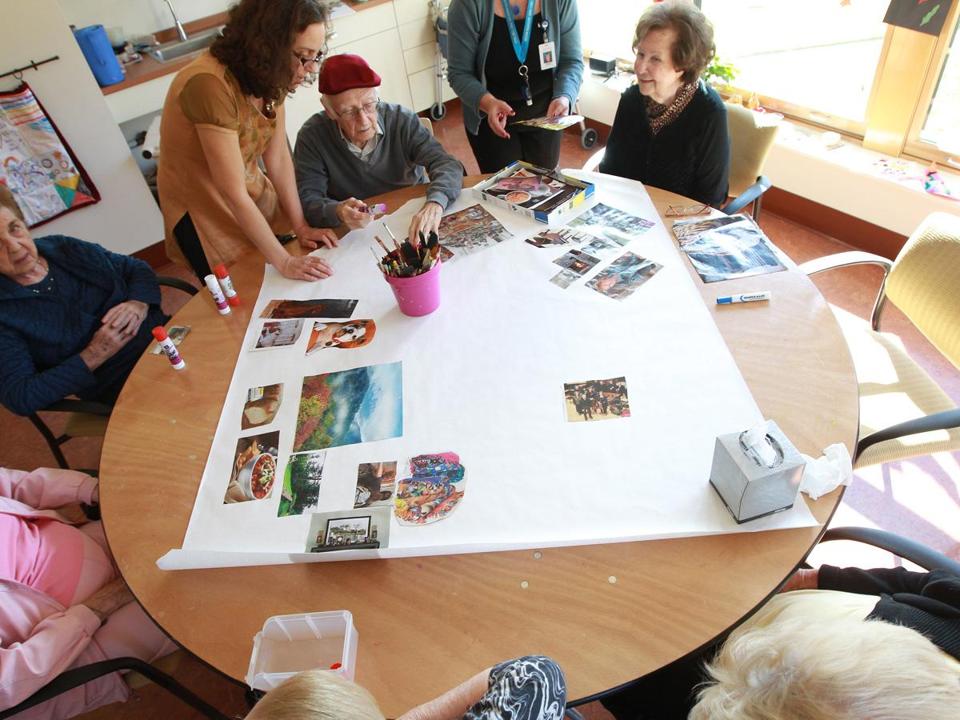
Asked at a recent class to make a collage of things that bring her comfort, Nancy pasted pictures of a kitchen, a wine glass, and a piano.
She didn’t make art as a younger person, according to her husband, but the coloring and collaging keeps her engaged and relatively happy in the class a few hours a week.
“There is, I would say, a calming influence when they’re in there,” said David, who spends six hours a day, four days a week with his wife.
Diana K. Miller, program manager of Nancy’s facility, said anxiety levels would rise without the classes, which give residents a sense of where they’re supposed to be and what they’re supposed to be doing. Art also helps people to continue communicating, even when they are losing their verbal abilities, she said. “Using music and art and movements that don’t rely on verbal skills allows people to succeed,” she said. “The primary language is emotion with this disease.”
In the music class on the floor below Nancy’s, the group remembered all the words to the Bing Crosby classic “Let Me Call You Sweetheart.” Then they played their instruments for a few minutes, while program coordinator Sally Harrison led them on her flute.
Someone accidentally bumped a switch and the overhead lights went out.
“Should’a paid the bill,” Clara piped up, before most of the others could get anxious about the loss of light.
“You should have been a standup comic,” Harrison told her. “Yeah, I look in the mirror and I laugh,” Clara shot back. “I look at your smile and I feel better,” her neighbor, Carla, responded. Harrison ended the class by making eye contact with each of the participants and sharing a smile. “So nice to be making music with all of you,” she said. “Love it,” Clara quickly replied.






 mediacionartistica