Como quien no quiere la cosa, sin aspavientos, a su manera sutil y sin alardes, el psiquiatra Francesc Tosquelles (Reus 1912 -Granges-sur-Lot 1994) y su rico legado están reapareciendo, justo cuando tanto de lo que nos rodea está la mar de alterado y ciertas cosas enloquecidas. Lo curioso es que no reaparece desde la institución médica, sino desde otros mundos.
La Fundació Andreu Nin le recordó en octubre como miembro siempre muy inteligente del antiestalinista POUM (Partit Obrer d’Unificació Marxista) y en el Macba puede verse hasta el 6 de enero “Práctica política, arte y clínica” el videoensayo que hace un año realizaron la artista visual Angela Melitopoulos y el psiquiatra Maurizio Lazzarato a partir de una entrevista de 1985, obra que han titulado con una palabra muy querida al doctor Tosquelles, «Déconnage», el efecto de la palabra francesa («déconner») que podemos traducir como «desbarrar» en catalán, decir disparates.
En paralelo, sin que ni unos ni otros se hayan puesto de acuerdo más allá de lo que el azar decide, el doctor Tosquelles también aparece por la exposición “L’art en guerre. Francia 1938-1947”, que hasta mediados de febrero puede verse en el Museo de Arte Moderno de París.
No es que los museos disparaten o «desbarren» sino que algo le debe el arte desde hace mucho al doctor Tosquelles y a su etapa en el manicomio de Saint-Alban, al que fue a trabajar tras la huida al terminar la guerra aquí. Allí trató al poeta Paul Éluard y a pintores surrealistas y de todo tipo que se hacían pasar por pacientes para no ser ingresados en campos de concentración como les sucedía a tantos judíos franceses y refugiados.
Escuchar al doctor Tosquelles es apasionante. Para él, «déconner», disparatar, es lo mejor que el terapeuta puede hacer para acercarse al paciente y lograr no ya comprenderlo sino que la persona desnortada deje de estar aislada. La psiquiatría, indica, sólo es aceptable si mira el mundo de otra forma, sin regularlo según el orden presente. A poco que uno se interese por estas cosas, no resulta extraño que el imaginativo y corajudo médico fuera en Francia el primero en valorar la tesis del psiquiatra que en este terreno acabaría por revolucionar tantas cosas, Jacques Lacan (“hablar cura”), tesis que Tosquelles hizo imprimir por vez primera, en Saint-Alban.
Pero nunca fue un terapeuta privado, siempre estuvo interesado en reformar la institución. Resumiendo, el doctor Tosquelles impulsó de manera decisiva, a partir de entender la salud mental desde fuera del sistema, cambios importantísimos en los manicomios de la época, lugares aterradores.
Nacido en Reus, se formó con el doctor Emili Mira, uno de los primeros traductores europeos de Freud. En el hospital Pere Mata el joven Tosquelles comprendió que lo que cura no es tanto escuchar al otro sino oírle: dejarle hablar, estar atento a la cadencia de sus frases, silencios, tono de voz, palabrotas, blasfemias. Por eso no quiso nunca hablar bien el francés, a propósito. Y siguió hablando su macarrónica jerga. Era su manera de presentarse ante el paciente, de decirle que él mismo estaba fuera de lugar, era un refugiado que había perdido su tierra y su lengua, que no podía sino decir aparentes disparates y que por ello sabía de qué iba la cosa, también él conocía lo que es sentirse perdido.
Es la misma actitud que, en plena guerra civil, le había permitido transformar la práctica médica. Logró hacer, por vez primera, terapia a soldados y a policías, y que prostitutas fueran aceptadas como personal sanitario. Le entrevisté en mis años de periodismo, sin saber nada de él, sólo que acababa de publicar un libro buenísimo, Funció poètica i psicoteràpia. Una lectura de In memoriam de Gabriel Ferrater (1985), hoy descatalogado. “Las guerras son curiosas”, me dijo con ironía ante mi desconcierto, “mucho más de lo que podemos imaginar”, y desde entonces que le doy vueltas al asunto. Reviviendo su legado, me pregunto cómo es que sabemos tan poco hoy de lo que sucede en los antes llamados manicomios y luego centros de salud mental.
In memoriam, doctor Tosquelles, quiero confiar en que su legado no se haya quedado en exclusiva en el museo, aunque me alegro de encontrarlo de nuevo ni que sea así, en exposiciones sobre el arte en guerra o en desvarío.
El contingut d’aquest dossier s’adreça a professionals i familiars que treballen l’atenció precoç amb aquests infants per tal de corregir i millorar els trastorns reals o potencials o per estimular capacitats compensadores. Totes les publicacions que s’hi recomanen es poden consultar als centres DIXIT.
Data de publicació: 11/12/2012
Elaborat per: DIXIT Centre de Documentació de Serveis Socials
Monografies
Atención temprana a niñas y niños sordos: guía para profesionales de los distintos ámbitos. Madrid: Fundación CNSE para la Supresión de las Barreras de Comunicación, 2007. Guia per a professionals de diferents àmbits que treballen en temes d’atenció precoç en nens i nenes amb sordesa. Està desenvolupada per la Fundació CNSE per a la supressió de les barreres de comunicació. Versió en línia (PDF) Avaluació externa de qualitat dels centres de l’ICASS: àrea de serveis. Centres de desenvolupament infantil i atenció precoç. Barcelona: Generalitat de Catalunya, Departament de Benestar Social, 2001. 57 p. Projecte d’avaluació externa de qualitat dels centres de desenvolupament infantil i atenció precoç, que permet avaluar la situació del sector a través d’un conjunt d’indicadors.
Cantavella, Francesc. Desenvolupament i salut mental: el valor de l’atenció en la primera infància. Barcelona: Publicacions i edicions de la Universitat de Barcelona, 2006. 141 p. + 1 CD-ROM. ISBN: 84-475-3133-3 Llibre orientat als professionals que treballen amb infants. Tracta temes tan fonamentals com la salut mental, les capacitats de l’infant, el seu desenvolupament, la prevenció, les particularitats dels nadons, els afectes o la malaltia.
Federación Estatal de Asociaciones de Profesionales de Atención Temprana – GAT. Organización diagnóstica para la atención temprana: niveles I, II y III. Madrid: Real Patronato sobre Discapacidad, 2011. 1 disc òptic (CD-ROM) Recurs que conté una classificació de diagnòstic que ordena les situacions de risc i trastorns que poden donar-se en l’etapa infantil de zero a sis anys, tant en infants i les seves famílies com al seu entorn, a través de la qual permet recollir un conjunt mínim de dades bàsiques sobre atenció precoç.
Federación Estatal de Asociaciones de Profesionales de la Atención Temprana – GAT. La primera notícia: estudio sobre los procedimientos profesionales, las vivencias y las necesidades de los padres cuando se les informa de que su hijo tiene una discapacidad o un trastorno del desarrollo. Madrid: Real Patronato sobre Discapacidad, 2011. 44 p. + 1 CD-ROM Estudi sobre els procediments professionals, les vivències i les necessitats dels pares quan se’ls informa que el seu fill/a té una discapacitat o un trastorn del desenvolupament. Versió en línia (PDF)
Federación Estatal de Asociaciones de Profesionales de Atención Temprana – GAT. La realidad actual de la atención temprana en España. Madrid: Real Patronato sobre Discapacidad, 2011. 250 p. + 1 CD-ROM. Estudi que mostra la situació actual i real a tot Espanya, de manera que es pugui reflexionar i valorar els aspectes qualitatius i quantitatius de l’atenció precoç, establir comparacions entre realitats, i obtenir unes conclusions que portin a millorar l’atenció a tots els infants del territori nacional i a les seves famílies. Versió en línia (PDF)
Giné, Climent. L’atenció precoç a Catalunya: serveis i qualitat. Barcelona: Generalitat de Catalunya, Departament de Benestar i Família, 2003. 185 p. Estudi elaborat el 2001 per analitzar la situació de l’atenció precoç a Catalunya, l’abast dels serveis que cobreix i la seva qualitat, és a dir, l’ajust de la resposta a les necessitats dels infants i les seves famílies. Per un altre costat, va permetre desenvolupar un model d’autoavaluació de la qualitat del servei a partir d’una concepció del servei centrada en la família. Versió en línia (PDF)
Gracia Millá, Mª; Mulas, Fernando. Atención temprana: desarrollo infantil, diagnóstico, transtornos e intervención. Valencia: Promolibro, 2005. XXIII, 915 p. Llibre que tracta els fonaments científics, el desenvolupament infantil, els aspectes conceptuals i organitzatius de l’atenció precoç, la prevenció, el procés, el diagnòstic, les capacitats i les intervencions específiques, la intervenció familiar, la formació i la investigació, els criteris i estàndards de qualitat i els projectes europeus en aquesta matèria.
Guía de estándares de calidad en atención temprana. Madrid: Real Patronato sobre Discapacidad, 2008. 158 p. + 1 CD-ROM Eina de referència per recolzar als serveis i als professionals implicats en l’atenció primerenca. Conté una sèrie d’estàndards per fer les autoavaluacions i les avaluacions externes pertinents dins d’aquest àmbit. Conté un CD-ROM amb l’aplicació informàtica GECAT.
Guia de serveis d’atenció precoç. Barcelona: Generalitat de Catalunya, Departament d’Acció Social i Ciutadania, 2010. 60 p. (Guies del DASC; 3) Guia que conté la relació d’establiments i centres que conformaven el Servei d’Atenció Precoç desplegat a Catalunya i que conformen la Xarxa de Centres de Desenvolupament Infantil i Atenció Precoç (CDIAP) l’any 2010.
Juegos, juguetes y atención temprana: pautas para el diseño de juguetes útiles en la terapia psicopedagógica. AIJU Centro Tecnológico, 2008. 32 p. Publicació que ofereix unes pautes per al disseny de joguines útils en teràpia psicopedagògica. S’inclou informació sobre la problemàtica de l’atenció precoç, les necessitats i requeriments que haurien de tenir les activitats lúdiques i les característiques que haurien de reunir els materials lúdics utilitzats en aquesta àrea d’intervenció infantil. Versió en línia (PDF)
Pérez Sánchez, Ma. Isabel; Lorenzo Rivero, Mª José. IDAT: inventario de desarrollo atención temprana. Salamanca: Amarú, 2001. 96 p. + 3 quaderns d’avaluació. Treball que fa una síntesi minuciosa de les conductes dels infants de 0 a 4 anys en cadascuna de les àrees que configuren el desenvolupament humà. Aquest document pot servir d’instrument de treball per a tots els nens i nenes, independentment del tipus de creixement i desenvolupament que estiguin tenint.
Perpiñán Guerras, Sonsoles. Atención temprana y familia: cómo intervenir creando entornos competentes. Madrid: Narcea, 2009. 252 p. Llibre que conté exemples d’experiències reals de casos d’atenció i estimulació precoç en infants dins l’àmbit familiar, explicant quines necessitats i quines són les emocions que s’experimenten quan apareix una situació de trastorn o risc en els fills. Està orientat principalment a psicòlegs, metges, treballadors socials, educadors i altres professionals de l’atenció primerenca i de la intervenció amb famílies.
Recomendaciones técnicas para el desarrollo de la atención temprana. Madrid: Real Patronato sobre Discapacidad, 2005. 40 p. Document de Federación Estatal de Profesionales de Atención Temprana, que té com a objectiu aportar als pares i mares, als professionals relacionats amb la primera infància, als experts de les administracions públiques i als gestors polítics, un conjunt de referències o recomanacions tècniques seleccionades per la seva rellevància per al desenvolupament infantil i l’atenció primerenca. Versió en línia (PDF)
Recull de procediments d’atenció directa per als centres de desenvolupament infantil i atenció precoç (CDIAP). Barcelona: Generalitat de Catalunya, Departament d’Acció Social i Ciutadania, 2010. 96 p. (Eines; 10) Publicació que recull els procediments bàsics en l’atenció directa dels infants que presenten necessitats, des que es detecten les dificultats i es planteja la demanda d’intervenció fins que, un cop diagnosticada i desenvolupada l’atenció terapèutica adequada l’infant rep la baixa del servei. Versió en línia (PDF)
Vint anys al servei de la petita infància i les seves famílies: jornada d’atenció precoç. Barcelona: Generalitat de Catalunya, Departament d’Acció Social i Ciutadania, 2007. 1 carpeta Material de la Jornada d’Atenció Precoç portada a terme a Lleida l’any 2007.
Revistes
Boletín del Real Patronato sobre Discapacidad Publicació electrònica de caràcter institucional del Real Patronato sobre Discapacidad que conté informació d’actualitat sobre aquest àmbit.
Desenvolupa: la revista d’atenció precoç Revista electrònica que dóna continuació a l’anterior publicació de l’Associació Catalana d’Atenció Precoç, la Revista de l’ACAP. Té com a objectiu fomentar el diàleg i l’intercanvi d’idees i experiències entre els professionals de les diferents disciplines que es dediquen o estan interessats en el desenvolupament infantil i l’atenció precoç.
Revista de psicopatología y salud mental del niño y del adolescente Publicació semestral que té com objectiu aprofundir en el coneixement teòric, la investigació, la pràctica clínica i l’atenció psiquiàtrica, en salut mental de la infància i l’adolescència.
Articles
Bagué Pietx, Joan. “La protecció de dades i altres qüestions derivades de l’atenció precoç”. A: Revista de l’ACAP, 2008, núm. 29, p. 51-72.
Bassols i Ginestà, Sílvia. “L’atenció a infants amb sordceguesa i a les seves famílies”. A: Revista de l’ACAP, 2009, núm. 30, p. 99-108.
Cristobal Mechó, Cristina. “Atenció precoç a Catalunya: una experiència assistencial amb passat i present”. A: Revista de l’ACAP, 2010, núm. 31, p. 9-27.
Diez Martínez, Arantxa. “Evolución del proceso de atención temprana a partir de la triada profesional-familia-niño”. A: Revista síndrome de Down, 2008, núm. 97, p. 46-55.
Mahoney, Gerald; Perales, Frida. “El papel de los padres de niños con síndrome de Down y otras discapacidades en la atención temprana”. A: Revista síndrome de Down, 2012 (jun.), vol. 29 (2), núm. 113, p. 46-64
Martín Tarrasón, Sergio. “Sobre la negación y el proceso de duelo”. A: Revista de l’ACAP, 2009, núm. 30, p. 75-95.
Molla Ollé, Josep. “El diagnòstic dels trastorns psíquics en la infància”. A: Revista de l’ACAP, 2010, núm. 31, p. 9-27.
Perera, Juan. “Atención temprana: definición, objetivos, modelos de intervención y retos planteados”. A: Revista síndrome de Down, 2011 (dic.), vol. 28 (4), núm. 111, p. 140-152
“Rol i funcions dels pedagogs/a en el CDIAP: document de treball, 6 d’octubre de 2011”. A: Educació i xarxa, 2012, núm. 6, p. 20-23
Recursos
Directori de centres de desenvolupament infantil i atenció precoç (CDIAP) Recull els 86 CDIAP (entre serveis i antenes, és a dir, serveis que només s’ofereixen algun dia de la setmana) distribuïts per tot el territori català.
Estimulacion Temprana: estimulación temprana para bebés y niños hasta 6 años – atención temprana Pàgina que conté una sèrie d’articles sobre l’estimulació precoç, així com informació sobre el curs que ha desenvolupat l’autora: «Aumenta la inteligencia de tu hijo de los 0 a los 6 años: estimulación temprana».
Guía de acceso a documentación de interés en atención temprana del Departamento de Investigación de Astrapace Pàgina que ofereix un conjunt de textos i documents que es consideren d’utilitat en el camp de l’atenció precoç.
Perfils professionals del servei d’atenció precoç L’any 2011, el Comitè d’Expertes i Experts en Formació en l’Àmbit de l’Acció Social del Departament de Benestar Social i Família va aprovar els perfils professionals del servei d’atenció precoç (neuropediatre/a, psicòleg/òloga, fisioterapeuta, logopeda, treballador/a social.
Institucions
ACAP. Associació catalana d’atenció precoç Entitat associativa que agrupa als professionals que treballen als Centres de Desenvolupament Infantil i Atenció Precoç (CDIAP) de Catalunya.
Federación estatal de asociaciones de profesionales de atención temprana Federació que aglutina al conjunt d’associacions de professionals de l’atenció precoç de les diverses comunitats autònomes de l’estat.
Normativa
Decret 261/2003 de 21 d’octubre, pel qual es regulen els serveis d’atenció precoç
Decret 142/2010, d’11 d’octubre, pel qual s’aprova la Cartera de Serveis Socials 2010-2011
Tercera edición de este evento científico internacional que reúne a investigadores e investigadoras cuyos intereses se sitúan en la intersección entre etnografía y educación, y con propuestas que reflejan una concepción amplia de la educación y los espacios educativos más allá, aunque sin excluir, del estudio de la enseñanza- aprendizaje en contextos formales-escolares.
La visión sobre la etnografía de la que parte esta reunión tiene sus raíces en la investigación antropológica, pero mantiene una mirada contemporánea de ésta y reconoce la naturaleza interdisciplinar de la etnografía. Por ello, el comité organizador espera recibir aportaciones desde la Antropología Social, la Comunicación, la Educación, la Geografía, la Lingüística, la Psicología o la Sociología, entre otros campos de las Ciencias Sociales. No obstante, en la selección de presentaciones se dará prioridad a propuestas de carácter empírico, más que meramente programáticas y/o conceptuales. Igualmente, se valorará especialmente la presentación de propuestas de investigación etnográfica que reflejen el carácter holístico y multi-técnico del trabajo de campo y, por tanto, incluyan una variedad de fuentes de información derivadas de observaciones, entrevistas y análisis de documentos, entre otras evidencias.
DEDHAM — Carla shook a tambourine, while Dorothy played the xylophone and Leni tapped her palms gently on an African drum. Vivian declined an instrument, but shimmied her shoulders when the music moved her.Their walkers stood ready and their voices were wispy with age, but the eight group members sang with purpose, remembering every word of the Doris Day classic without prompting.
“We were sailing along, on Moonlight Bay. We could hear the voices ringing . . .,” they sang.
When they had finished “love’s old sweet song” and given themselves a round of applause, Clara proclaimed the group “ready for Symphony Hall.”
This music class at Hebrew Senior Life’s NewBridge on the Charles campus is what today’s cutting-edge Alzheimer’s treatment looks like.
Medications can’t stop the disease’s inexorable damage to the mind, and stress and agitation often remain challenging despite drug treatment. But a growing number of Alzheimer’s institutions and caregivers are realizing that a musical walk down memory lane — a dance class, storytelling session, art project, or museum tour — can do more than offer pleasant diversions. They can improve a number of disease symptoms as well as quality of life.
ESSDRAS M SUAREZ/GLOBE STAFF In the music class at NewBridge on the Charles, Dorothy plays percussion and therapist Sally Harrison plays the flute. At a recent conference titled Artz and Dementia, some 150 Boston-area health professionals gathered at NewBridge on the Charles to learn how to provide the most benefit for people who are losing mental abilities.
The basic idea is to use art to engage and connect with people with dementia, said John Zeisel , president and cofounder of Hearthstone Alzheimer Care. No matter how many memories they’ve lost, an essential piece of who they always were still remains, said Zeisel, author of “I’m Still Here,” a 2009 book that focuses on this approach.
“It’s a human rights issue that everybody needs to be able to have a life,” Zeisel told conference attendees. “What is a life without creativity and art and discovery and learning?”
Even people who were not artistic or music lovers in their youth can be inspired by the sound of a song they heard on their first date, or by a painting that evokes an emotion, the speakers said.
For one woman, listening to Frank Sinatra brought her back to the happy summers of her teens when she would fall asleep by the radio, Marian Brown, associate director of Artz: Artists for Alzheimer’s, told the crowd. “For her, it was very clearly something that triggered a deep-rooted memory,” Brown said. Recent memories and thinking ability may decline with Alzheimer’s, but long-term memories are still there, as are emotions.
“We don’t lose the ability to express joy,” added her colleague, Dee Brenner, Artz program coordinator.
The two help organize weekly local museum tours for people with Alzheimer’s, and walked conference audience members through some basic strategies for making such visits successful: Greet people when they arrive, remind them where they are, and make sure the artwork is big enough to be visible to a group.
“How does this make you feel? What do you see?” Brenner asks when leading a tour. She’ll avoid violent or disturbing images — but not sexual ones, which spur conversation, she said.
One of the key benefits of doing or appreciating art, Zeisel said, is that it challenges people who are usually doted on. “When you are cared for, you lose your sense of who you are,” he said. “Everybody with dementia has a lot going for them. They can experience, they can be present, and they can develop.” In the six facilities Zeisel’s organization runs in Massachusetts and New York, residents are encouraged to participate in regular artistic activities. They can usually choose between two activities at a time, and can also opt out.
At Hearthstone’s Marlborough residence, some 35 of the home’s 45 residents used to get agitated in the evenings, a common problem in Alzheimer’s known as sundowning. But when music therapist Joshua J. Freitas started playing soothing instrumental music at dinner time — he’s partial to recordings by cellist Yo-Yo Ma — most of the residents relaxed. Now, on a typical day, only eight or 10 need extra help from the staff.
Robert Stern, a professor of neurology and neurosurgery at Boston University, said a growing body of research is confirming the anecdotal evidence that the arts can improve quality of life, reduce stress, and allow the person to better connect to the world. Recent research suggests music can boost recall of personal memories. “Whether it be fine arts, music, listening to music, going to museums. All those things do not have an impact on the disease per se. What they do most likely is they get through to the person with Alzheimer’s by exploiting the areas of the brain which are least impaired,” said Stern, also the director of BU’s Alzheimer’s Disease Center’s Clinical Core. “Anything that can touch the patient through that network of brain [areas] can have a profound impact.” Medications such as cholinesterase inhibitors may be able to slow some of the memory loss of Alzheimer’s and allow people to live independently longer. But all of the efforts to develop drugs to reverse memory loss and the behavioral changes of Alzheimer’s have failed so far. Researchers think that’s because the damage of Alzheimer’s begins years, if not decades before symptoms become obvious. They are now testing drugs in people likely to develop the disease, to see if they are more effective. Instead of just warehousing dementia patients until more effective medications are discovered or patients die, Zeisel said, “Our present challenge is to provide people with a life worth living while they’re alive.” Dance therapist Donna Newman-Bluestein said one vehicle for a life worth living is dance. As long as people have bodies, they are capable of — and should be given an opportunity for — moving and dancing, she told the attendees at last month’s conference.
People with dementia often lack the initiative to begin movement on their own, so they sit, immobile for hours, Newman-Bluestein said. “If someone else gets them going, they can engage, and they can move a lot more.”
The medical model of treating Alzheimer’s is to focus on what someone isn’t doing and try to fix it, she said. The arts model looks at what they are doing and tries to build on that ability.
“I see joy when they’re moving. I see them transformed by their movement,” she said Writers and poets also see their art as a way to reach people, regardless of age or prognosis. “Story and poetry helps connect to the person within,” said Alan O’Hare, a storyteller and playwright who often works with Alzheimer’s patients.
He described one nursing home resident he had largely ignored because she spent most of the day doing nothing but moving her eyes diagonally up and down. He decided to ask her about it. “I’m dancing all day,” she told him. Hearing that “changed my whole relationship with her,” O’Hare said. David Kaplan of Waltham said he’s seen his wife, Nancy, benefit somewhat from the art classes she gets in the NewBridge memory care unit.
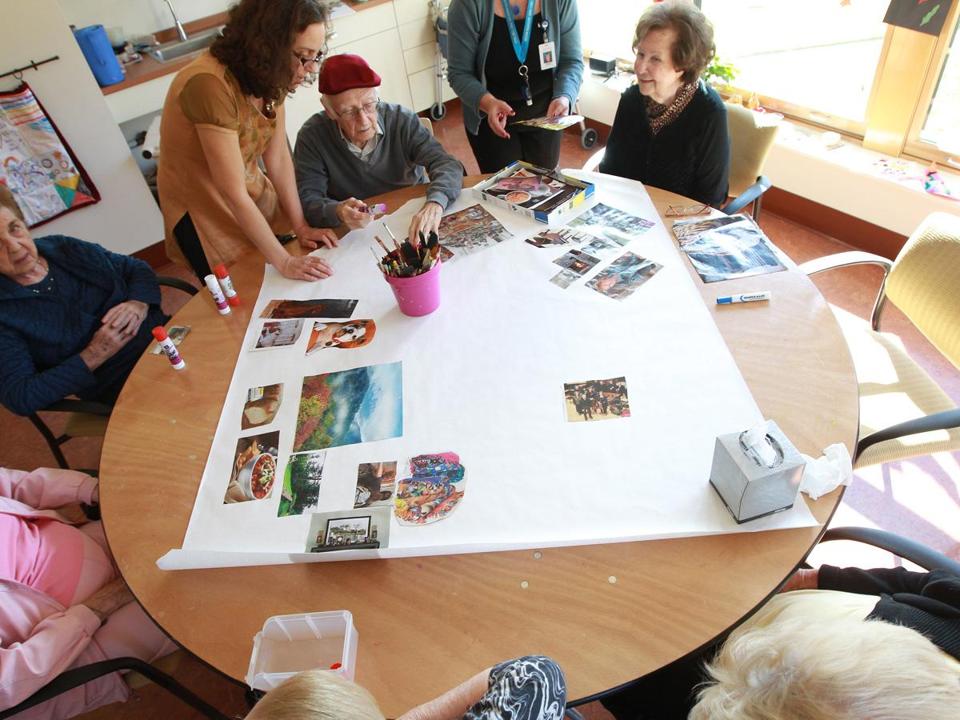
Asked at a recent class to make a collage of things that bring her comfort, Nancy pasted pictures of a kitchen, a wine glass, and a piano.
She didn’t make art as a younger person, according to her husband, but the coloring and collaging keeps her engaged and relatively happy in the class a few hours a week.
“There is, I would say, a calming influence when they’re in there,” said David, who spends six hours a day, four days a week with his wife.
Diana K. Miller, program manager of Nancy’s facility, said anxiety levels would rise without the classes, which give residents a sense of where they’re supposed to be and what they’re supposed to be doing. Art also helps people to continue communicating, even when they are losing their verbal abilities, she said. “Using music and art and movements that don’t rely on verbal skills allows people to succeed,” she said. “The primary language is emotion with this disease.”
In the music class on the floor below Nancy’s, the group remembered all the words to the Bing Crosby classic “Let Me Call You Sweetheart.” Then they played their instruments for a few minutes, while program coordinator Sally Harrison led them on her flute.
Someone accidentally bumped a switch and the overhead lights went out.
“Should’a paid the bill,” Clara piped up, before most of the others could get anxious about the loss of light.
“You should have been a standup comic,” Harrison told her. “Yeah, I look in the mirror and I laugh,” Clara shot back. “I look at your smile and I feel better,” her neighbor, Carla, responded. Harrison ended the class by making eye contact with each of the participants and sharing a smile. “So nice to be making music with all of you,” she said. “Love it,” Clara quickly replied.
Propuestas pedagógicas para trabajar en las escuelas
Desde el año 2004 la organización desarrolla el proyecto “Arte e Inclusión Social, formación y capacitación docente en técnicas dramáticas no convencionales”. Se trata de una valiosa herramienta que le permitirán al docente mejorar la calidad de la comunicación, estimular la expresión y despertar el interés por el conocimiento.
Judith Scott es la persona más conocida del centro, por su obra y por la película que contribuyó a hacerla famosa: Qué tienes debajo del sombrero
Ponencia donde se presenta el centro: CREATIVE GROWTH ART CENTER: CÓMO EL ÉXITO CREATIVO DIO PASO AL ÉXITO SOCIAL: CREATIVE GROWTH ART CENTER
II Congreso sobre daño cerebral adquirido en la Comunidad Valenciana. Desde el déficit hasta la actividad y participación social. Temática: Ocio y Participación Social. Andreu-Sánchez, Celia (UAB-UdG) y Martín-Pascual, Miguel Ángel (UAB-IRTVE)
Guy Kawasaki nos cuenta en su último libro El arte de cautivar: Cómo se cambian los corazones, las mentes y las acciones, cómo los grandes ponentes profesionales repiten la misma presentación una y otra vez, haciendo sentir a la audiencia que es la primera vez que la dan. ¿Cuál es la clave? La personalización. Aunque repitas mil veces la misma presentación ante mil audiencias distintas, asegúrate de cambiar en cada ocasión una parte de la misma: la introducción. Crea en los momentos iniciales una conexión emocional con cada audiencia introduciendo algo específico para ella. Sorpréndela con algo que no imaginaba que podrías conocer sobre ella.
En el enlace adunto see encuentran los siete puntos que el autor propone para vincular a la audiencia.
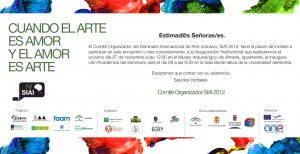
Financiado por el programa “Juventud en Acción” de la Unión Europea y gracias al esfuerzo de las entidades organizadoras y colaboradoras, el Seminario Internacional de Arte Inclusivo (SIAI), se desarrollará del 27 al 30 de noviembre en la Universidad de Almería (Andalucía, España), mediante un programa de conferencias, videoconferencias, mesas redondas, masterclass y exposiciones a cargo de expertos y profesionales en las distintas materias artísticas. Representantes de Alemania, Colombia, España, Polonia, Rusia y Ukraina, mostrarán el trabajo artístico, creativo, inclusivo y terapéutico, que realizan en sus diferentes organizaciones..
«El Departamento de Educación de Manifesta 8, Bienal itinerante Europea de Arte Contemporáneo, abre una convocatoria para la contratación de mediadores en arte contemporáneo. Pueden solicitar este trabajo recién licenciados o estudiantes de Magisterio, Pedagogía, Historia del Arte, Diseño, Bellas Artes y/ u otros estudios relacionados con el arte. Licenciados o estudiantes de otras disciplinas como Filosofía o Sociología también pueden aplicar a estas plazas.
Manifiesta 8
En el marco de Manifesta 8 los mediadores artísticos serán los encargados de mediar con y desde el contexto y el contenido artístico de la bienal con diferentes audiencias como escuelas de primaria, secundaria, universitarios, adultos y otros grupos de interés especial. El programa de mediación artística de Manifesta 8 se basa en prácticas educativas. Los participantes trabajarán supervisados por las coordinadoras de educación y tendrán la oportunidad única y excepcional de obtener una valiosa experiencia laboral a la vez que forman parte de un equipo internacional de artistas y profesionales del arte.
El período de trabajo será desde la última semana de septiembre 2010 hasta la primera semana de enero 2011. Sesiones de formación y preparación se celebrarán en julio (8-11) y en septiembre 2010
Las tareas serán: Estudiar el formato y el contenido de Manifesta 8; Participar activamente en el desarrollo del programa educativo de Manifesta 8; y conducir de visitas guiadas, talleres y otras actividades educativas. Entre las habilidades requeridas figuran: buen conocimiento del arte contemporáneo; disponibilidad; dominio de los idiomas inglés y español (se valorarán conocimientos de otros idiomas); sentido del humor y excelentes habilidades comunicativas; formación en pedagogía o en didáctica no es obligatoria pero se valorará.
Para entrar en el proceso de selección como mediadores artísticos se ha de enviar un currículum vitae y una carta de motivación (extensión máxima de un folio), explicando estas cuestiones: ¿por qué estás interesado en trabajar como mediador en Manifesta 8, la Bienal Europea de Arte Contemporáneo?; Describe a alguna persona o experiencia que haya influenciado tu percepción del arte.
La solicitud se puede enviar a: mediacion@manifesta8.es (archivos adjuntos en PDF o en formato Microsoft Word). La fecha límite de envío de solicitudes es el 6 de junio.
Publicado el 16/05/2010 en http://infoenpunto.com/not/1711/ (fecha de consulta 13/11/2012). Lo publico porque es la primera vez que veo una oferta de trabajo en que se busque un «mediador artístico», ya que como sabeis laMediación Artística como tal es un concepto nuevo.