Hi participa l’Alexandra Belmonte, que va ser alumne meva.
Felicitats per la feina, Alex.


En la literatura sobre el tema, los autores han coincidido que los objetivos básicos en el arte terapia con jóvenes víctimas de abuso sexual es la restauración y reafirmación constante de los límites debido a la transgresión de la totalidad de los límites de la persona. “Los límites necesitan ser reconstruidos trabajando en pos de que sean confiables y que automáticamente protejan al niño. (…)
Artículo completo en el enlace: Arte y reparación abuso sexual (fecha de consulta 06/12/2012)
kdm;) tv, Cuenta las aventuras de un grupo de adolescentes que intentan montar su propio canal de televisión por internet. En este primer capítulo podrás conocer a los personajes que le dan vida. La interculturalidad está presente. Ellos quieren tener su propio canal, ¿lo conseguirán?.

Publicación de Uruguay sobre el arte como instrumento de integración social.
DEDHAM — Carla shook a tambourine, while Dorothy played the xylophone and Leni tapped her palms gently on an African drum. Vivian declined an instrument, but shimmied her shoulders when the music moved her.Their walkers stood ready and their voices were wispy with age, but the eight group members sang with purpose, remembering every word of the Doris Day classic without prompting.
“We were sailing along, on Moonlight Bay. We could hear the voices ringing . . .,” they sang.
When they had finished “love’s old sweet song” and given themselves a round of applause, Clara proclaimed the group “ready for Symphony Hall.”
This music class at Hebrew Senior Life’s NewBridge on the Charles campus is what today’s cutting-edge Alzheimer’s treatment looks like.
Medications can’t stop the disease’s inexorable damage to the mind, and stress and agitation often remain challenging despite drug treatment. But a growing number of Alzheimer’s institutions and caregivers are realizing that a musical walk down memory lane — a dance class, storytelling session, art project, or museum tour — can do more than offer pleasant diversions. They can improve a number of disease symptoms as well as quality of life.
ESSDRAS M SUAREZ/GLOBE STAFF In the music class at NewBridge on the Charles, Dorothy plays percussion and therapist Sally Harrison plays the flute. At a recent conference titled Artz and Dementia, some 150 Boston-area health professionals gathered at NewBridge on the Charles to learn how to provide the most benefit for people who are losing mental abilities.
The basic idea is to use art to engage and connect with people with dementia, said John Zeisel , president and cofounder of Hearthstone Alzheimer Care. No matter how many memories they’ve lost, an essential piece of who they always were still remains, said Zeisel, author of “I’m Still Here,” a 2009 book that focuses on this approach.
“It’s a human rights issue that everybody needs to be able to have a life,” Zeisel told conference attendees. “What is a life without creativity and art and discovery and learning?”
Even people who were not artistic or music lovers in their youth can be inspired by the sound of a song they heard on their first date, or by a painting that evokes an emotion, the speakers said.
For one woman, listening to Frank Sinatra brought her back to the happy summers of her teens when she would fall asleep by the radio, Marian Brown, associate director of Artz: Artists for Alzheimer’s, told the crowd. “For her, it was very clearly something that triggered a deep-rooted memory,” Brown said. Recent memories and thinking ability may decline with Alzheimer’s, but long-term memories are still there, as are emotions.
“We don’t lose the ability to express joy,” added her colleague, Dee Brenner, Artz program coordinator.
The two help organize weekly local museum tours for people with Alzheimer’s, and walked conference audience members through some basic strategies for making such visits successful: Greet people when they arrive, remind them where they are, and make sure the artwork is big enough to be visible to a group.
“How does this make you feel? What do you see?” Brenner asks when leading a tour. She’ll avoid violent or disturbing images — but not sexual ones, which spur conversation, she said.
One of the key benefits of doing or appreciating art, Zeisel said, is that it challenges people who are usually doted on. “When you are cared for, you lose your sense of who you are,” he said. “Everybody with dementia has a lot going for them. They can experience, they can be present, and they can develop.” In the six facilities Zeisel’s organization runs in Massachusetts and New York, residents are encouraged to participate in regular artistic activities. They can usually choose between two activities at a time, and can also opt out.
At Hearthstone’s Marlborough residence, some 35 of the home’s 45 residents used to get agitated in the evenings, a common problem in Alzheimer’s known as sundowning. But when music therapist Joshua J. Freitas started playing soothing instrumental music at dinner time — he’s partial to recordings by cellist Yo-Yo Ma — most of the residents relaxed. Now, on a typical day, only eight or 10 need extra help from the staff.
Robert Stern, a professor of neurology and neurosurgery at Boston University, said a growing body of research is confirming the anecdotal evidence that the arts can improve quality of life, reduce stress, and allow the person to better connect to the world. Recent research suggests music can boost recall of personal memories. “Whether it be fine arts, music, listening to music, going to museums. All those things do not have an impact on the disease per se. What they do most likely is they get through to the person with Alzheimer’s by exploiting the areas of the brain which are least impaired,” said Stern, also the director of BU’s Alzheimer’s Disease Center’s Clinical Core. “Anything that can touch the patient through that network of brain [areas] can have a profound impact.” Medications such as cholinesterase inhibitors may be able to slow some of the memory loss of Alzheimer’s and allow people to live independently longer. But all of the efforts to develop drugs to reverse memory loss and the behavioral changes of Alzheimer’s have failed so far. Researchers think that’s because the damage of Alzheimer’s begins years, if not decades before symptoms become obvious. They are now testing drugs in people likely to develop the disease, to see if they are more effective. Instead of just warehousing dementia patients until more effective medications are discovered or patients die, Zeisel said, “Our present challenge is to provide people with a life worth living while they’re alive.” Dance therapist Donna Newman-Bluestein said one vehicle for a life worth living is dance. As long as people have bodies, they are capable of — and should be given an opportunity for — moving and dancing, she told the attendees at last month’s conference.
People with dementia often lack the initiative to begin movement on their own, so they sit, immobile for hours, Newman-Bluestein said. “If someone else gets them going, they can engage, and they can move a lot more.”
The medical model of treating Alzheimer’s is to focus on what someone isn’t doing and try to fix it, she said. The arts model looks at what they are doing and tries to build on that ability.
“I see joy when they’re moving. I see them transformed by their movement,” she said Writers and poets also see their art as a way to reach people, regardless of age or prognosis. “Story and poetry helps connect to the person within,” said Alan O’Hare, a storyteller and playwright who often works with Alzheimer’s patients.
He described one nursing home resident he had largely ignored because she spent most of the day doing nothing but moving her eyes diagonally up and down. He decided to ask her about it. “I’m dancing all day,” she told him. Hearing that “changed my whole relationship with her,” O’Hare said. David Kaplan of Waltham said he’s seen his wife, Nancy, benefit somewhat from the art classes she gets in the NewBridge memory care unit.
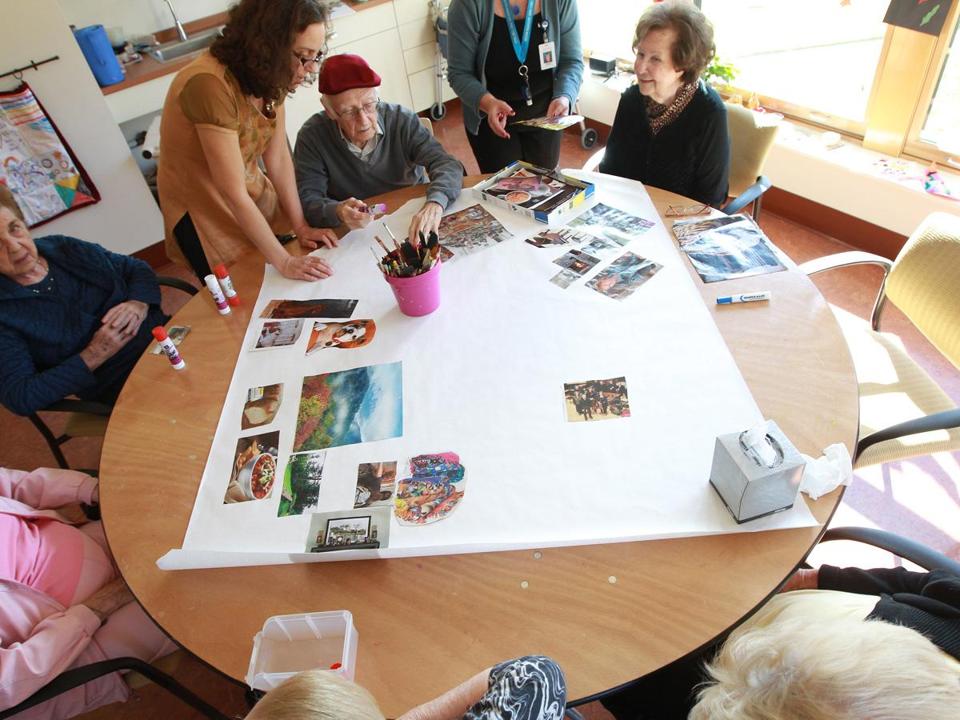
Asked at a recent class to make a collage of things that bring her comfort, Nancy pasted pictures of a kitchen, a wine glass, and a piano.
She didn’t make art as a younger person, according to her husband, but the coloring and collaging keeps her engaged and relatively happy in the class a few hours a week.
“There is, I would say, a calming influence when they’re in there,” said David, who spends six hours a day, four days a week with his wife.
Diana K. Miller, program manager of Nancy’s facility, said anxiety levels would rise without the classes, which give residents a sense of where they’re supposed to be and what they’re supposed to be doing. Art also helps people to continue communicating, even when they are losing their verbal abilities, she said. “Using music and art and movements that don’t rely on verbal skills allows people to succeed,” she said. “The primary language is emotion with this disease.”
In the music class on the floor below Nancy’s, the group remembered all the words to the Bing Crosby classic “Let Me Call You Sweetheart.” Then they played their instruments for a few minutes, while program coordinator Sally Harrison led them on her flute.
Someone accidentally bumped a switch and the overhead lights went out.
“Should’a paid the bill,” Clara piped up, before most of the others could get anxious about the loss of light.
“You should have been a standup comic,” Harrison told her. “Yeah, I look in the mirror and I laugh,” Clara shot back. “I look at your smile and I feel better,” her neighbor, Carla, responded. Harrison ended the class by making eye contact with each of the participants and sharing a smile. “So nice to be making music with all of you,” she said. “Love it,” Clara quickly replied.
 Artículo: CINE Y EDUCACIÓN SOCIAL
Mª CARMEN PEREIRA DOMÍNGUEZ
Revista de Educación, num 338 (2005), pp.205-228
El presente artículo trata de demostrar cómo el cine puede ser un elemento claramente formativo, además de un apoyo metodológico en la intervención pedagógica y hace incidencia en algunas profesiones que pueden aprovecharse del séptimo arte como soportes de complementación profesional. La historia y desarrollo del cine como arte e industria y la pléyade de directores que han hecho películas que ayudan a la conformación de una escala de valores son argumentos suficientes para que podamos contar con el cine como un recurso didáctico para hacer una pedagogía más acorde con la realidad de los tiempos que vivimos.

Web de la cooperativa: en Argentina: http://recooparte.blogspot.com.es/
Propuestas pedagógicas para trabajar en las escuelas
Desde el año 2004 la organización desarrolla el proyecto “Arte e Inclusión Social, formación y capacitación docente en técnicas dramáticas no convencionales”. Se trata de una valiosa herramienta que le permitirán al docente mejorar la calidad de la comunicación, estimular la expresión y despertar el interés por el conocimiento.

CONGRESO INTERNACIONAL DE INTERVENCIÓN SOCIAL, ARTE SOCIAL Y ARTETERAPIA. De la Creatividad al Vínculo Social
28, 29, 30 de Noviembre y 1 de Diciembre 2012
Texto de la ponencia: Mediación Artística y Arteterapia: una primera cartografía

La cárcel: ¿Un tránsito hacia la reinserción en la vida activa? Algunas voces de los participantes en el taller de fotografía del penal de los Olmos (La Plata- Argentina-). Ponencia invitada en el V Congreso de Educación Artística. Jaén. 2012.
Texto de la ponencia: La cárcel Ponencia Jaen

La Universidad Completense de Madrid edita esta revista donde se publican tanto artículos de Arteterapia como de Mediación Artística.
Enlace a la revista: http://revistas.ucm.es/index.php/ARTE
Presentación: Esta publicación viene a llenar el vacío de editorial para aquellas personas que desde distintos ámbitos (arte, psicología, medicina, psicoanálisis, educación social, creación plástica) estén interesadas en el arteterapia. La revista abordará diversos aspectos del arteterapia (clínicos, educativos y sociales) y aquellos ámbitos que busquen una mayor inclusión social a través de medios artísticos.

